We hope you enjoy browsing through the records on this page to discover the wide range of habitats and species which may be found on the Green. Habitats are displayed to begin with, allowing you to learn about them before clicking or tapping on the wildlife links. Where there is a down arrow ( ) additional information is available. Feedback on this page would be welcome to enable us to develop it further: Email
Read introduction
As well as providing a community space the role of trustees of Millennium Greens is to provide opportunities for people to experience nature first-hand.The national State of Nature Report, (published September 2023), shows that the UK is one of the most nature-depleted countries in the world, and wildlife continues to decline. But there’s been evidence of success in nature recovery even in small spaces, and the trustees of Landkey’s Green are making their contribution.
If you are reading this on the Green please make your way to the board by the holly bushes in the centre of the Green. There is a map which will help you locate the different areas and features which are described below.
What is now the Green has been farmed for centuries. Above the football field two former fields, West Close and East Close, are divided by an ancient hedge bank. Recently the Green had been used as pasture for cattle. Now the Green has a rich mixture of natural homes for wildlife, called habitats: woodland, wild flower meadow, hedge bank, mazzard orchard, old leat wetland, and the stream. There are small posts identifying each feature. What you see are described on this page.
Records of birds, plants and other natural features are being recorded, so that we’ll know the value of the Green for wildlife, and how this value is being enhanced. Lists are available. If you can help with this valuable work please get in touch.
What’s here: The top woodland was planted when the Green was established. What’s here may look as if it has been there for many decades, but like the rest of the Green is only a quarter of a century old. Varieties planted included quick-growing (and sometimes unstable) poplar and willow which came to suppress some of the slower-growing trees, particularly oak. Ash did well until the arrival of die-back disease, so the ash were removed, followed by most of the poplar and willow.
There are in a way three parts of the wood: the original trees which form a canopy, an understorey of shrubs and other plants that flourish in partial shade, and a belt of newer planting on the lower southern edge.
What to look out for: The canopy is made up of a few remaining poplar, willow and ash with oak, chestnuts (mostly sweet), alder, birch, field maple and rowan. Underneath there are hazel and holly. The newer planting includes field maple, sycamore and buckthorn. There are now snowdrops, bluebells, primrose and foxgloves growing on the floor of the wood with honeysuckle introduced recently.
The woodland produces cover for birds and nesting sites thanks to the boxes. In the Spring you are likely to see great and blue tits plus goldfinches and siskins feeding in the trees and using the nest boxes. (A full list of birds seen on the Green is being prepared.)
Longer term aims: Nature will be encouraged by the modest increase in the woodland’s size and the sensitive management of the woodland floor to provides a more cover and variety.
Habitats
Meadow
What’s here: The Plan for the Millennium Green which was agreed in 1999 included an area of wildflower meadow. But the efforts to establish one ran into difficulties. In 2000, with trustees being aware of their obligations to encourage Nature, it was decided to have another try on the western side of the Green. Over the last few years there is yet more evidence of the value of the establishment of small nature-friendly areas such as on the Green or in gardens. Wildflowers are good for pollinating insects, needed in the food chain. Advice has been kindly offered by RHS Rosemoor who showed that conversion of a former pasture into a valuable and lovely meadow is possible but takes time and effort.
What’s happening: There are four key management tasks at different times of the year In the SPRING the meadow is mown and wildflower sown on the barest areas. Then during late SPRING and SUMMER the wildflowers grow up amongst the grasses. Small plug-grown wildflowers are planted out. Well after the flowers have seeded in late SUMMER the grass is cut back and later taken away, like a hay crop. Over the years this practice reduces the fertility for grasses making it easier for wildflowers. This is why, in the AUTUMN, strips are scarified (surface turf removed), for sowing with seed of yellow rattle, a plant which is semi-parasitic on grasses enabling wild flowers to flourish with more vigour.
What to look out for: The flowers and pollinators change as the season progresses - a full list of what might be seen over the whole year is provided elsewhere. For flowers early on, alongside daisies, (common and ox-eye) and dandelions look out for yellow rattle. Later plants such as bird’sfoot trefoil, cornflower,common knapweed, poppy, red clover and ribwort plantain provide a wider range of colours.
Longer term plans: The work described above will be needed every year and may be extended to parts of the apple orchard if more voluntary help is available. The acquisition of a scarifier will ease the burden!
Habitats
Hedge Bank
What’s here? The Green is surrounded by old hedges and new beech hedges were planted in 2000 to demarcate it from the football field. There is also a hedge bank dividing the top part of the Green in two, -the part to the west (now including woodland and meadow) was known as West Close, and that to the east (now the orchard) was East Close. The term ‘close’ means enclosed land, not open common land.
The line is known from the tithe map (c1840) and this, combined with the names, could mean that the hedge bank is even older, telling us a little about Landkey’s agricultural history. Think of ploughmen and oxen with primitive ploughs centuries ago, and feel grateful to be spared that hard labour!
What to see: The hedge bank has been planted with berry-bearing shrubs, mostly hawthorn but also spindle, guilder rose and dog rose which provide winter feed for birds. While the plants grow up there are not many berries or birds, but you may see blackbirds, song thrushes and redwings feeding. Below the arch the hedge bank is mostly covered in snowberries, with blackthorn (sloe) near the football field.
Future Plans: As the hedge on the top bank develops there may be hedge laying at some stage to make it thicker and friendlier for hedgehogs and nesting birds.
Habitats
Mazzard Orchard
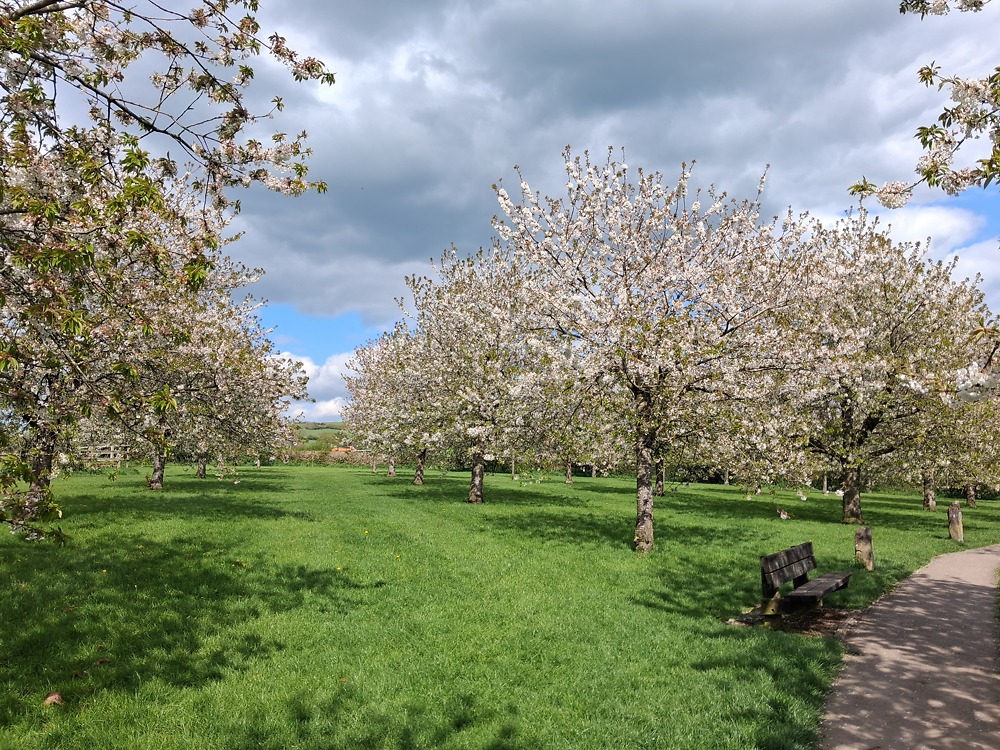
What to see: There are sixty mazzard trees, plus half a dozen apple trees (at the top). Mazzards are an ancient cherry variety with small black fruit, closely linked to Landkey (see below). The apples are all Devon varieties (see below). From mid to late April the mazzard trees are covered in white blossom, with fruit following in July. By looking at the trees near ground level it is possible to see a bulge where there is the union between graft and rootstock.
Mazzard Orchard Story: The Mazzard Orchard, with large trees producing white blossom and small black cherries, is more special than many realise. In ancient times mazzard trees were domesticated from wild cherry (prunus avium) trees, and were grown around the country. From medieval and Tudor times different cherries (prunus cerasus) were introduced, and with them the word ‘cherry’. While most parts of the country replaced mazzards with the new ‘cherries’, mazzards continued to be grown in North Devon until the twentieth century, when most orchards disappeared. Around 1990, when a Save our Orchards campaign was established in North Devon, one of its first objectives was ‘saving the North Devon mazzard’, by then reduced to a few ancient trees east of Barnstaple, particularly in Landkey, Goodleigh and Atherington. A few new trees had been produced in the 1970s by Fred Harris of Westacott Nurseries, but most remaining trees were very ancient. The future for this distinctive North Devon fruit seemed bleak.
In the late 1990s Campaign enthusiasts collected grafting material of different varieties and Kevin Croucher of Thornhayes Nurseries produced new trees. Dick Joy, Chairman of Landkey Parish Council, was keen to see a number of young trees planted in the village. The new National Lottery with its funding of Millennium projects provided the opportunity to establish a new mazzard orchard, and a funding application was successful. In December 1999 Landkey had its first new mazzard orchard of over sixty trees, (on Colt rootstock) on the new Millennium Green.
It took a decade for trees to grow and start looking like an orchard. In early years most fruit was eaten by birds. 2015 will be remembered in Landkey as the year of the mazzards’ return. The large trees on the Millennium Green fruited in such quantity that birds were defeated and there was a big crop for humans to pick and enjoy. For the first time it has been possible to compare the different varieties of the fruit on the Green, -Bottler, Dun, Greenstem Black, Hannaford and Small Black. There is some doubt about nomenclature: when it comes to defining varieties there is always more work to be done!
Apple Orchard: Listener, Limberlimb and Stockbearer are all varieties associated with Landkey and were planted on the Green. To mark the 70th Anniversary of Queen Elizabeth II's reign a Devonshire Quarrendon was planted in 2022. To continue the support for wildlife recovery the top section of the orchard, where the apple trees grow, is left uncut with some wildflower planting as well.
Habitats
Old Leat Wetland
Places where land and water meet are important to many forms of wildlife....
What’s here: The ditch beneath the hedge to the north of the Tarka Trail path has interesting origins. It is the remains of a leat, a channel of water, which took water from a weir on the stream to Castle Mill beyond the village hall where it powered the sawmill wheel. The weir and mill have gone, and the rest of the leat is buried beneath the football field and village car park. However, the old leat is identifiable as a surface drain, collecting water from the fields above it which is piped under the path and in to the stream. Nevertheless it provides the only home on the Green for damp-loving reptiles, insects and plants.
What to look out for: In the early part of the year there is frogspawn and tadpoles. In midsummer there are damsel flies and dragonflies darting about above a leat full of vegetation including hemlock, marsh marigold and water mint.
Longer term aims: The lack of constantly flowing water means silt is not carried away and over time builds up in the leat requiring clearance every decade or so, last done in 2024. This cycle in itself provides interesting ecological variety and will be maintained. In the longer term nature would benefit if the leat could be widened and water flow sustained, but this would be a significant project.
Birds
Barn Swallow
Hirundo rustica
Line spacer
Plants
Birdsfoot Trefoil
Lotus corniculatus
Line spacer
Plants
Bistort , Common
Persicaria bistorta
Line spacer
Birds
Blackbird
T. merula
Has been observed on the Green
Most likely to be seen in spring (Mar-May)
Birds
Blackcap
S. atricapilla
Has been observed on the Green
Plants
Bluebell
Hyacinthus non-scripta
Has been observed on the Green
Most likely to be seen in spring (Mar-May)
In the woodland area
Birds
Bullfinch
Pyrrhula pyrrhula
Has been observed on the Green
Plants
Buttercup, Creeping
Ranunculus repens
Line spacer
Birds
Carrion Crow
C. corone
Has been observed on the Green
Plants
Carrot , Wild
Daucus carota
Line spacer
Birds
Chiffchaff
P. collybita
Has been observed on the Green
Birds
Coal Tit
P. ater
Has been observed on the Green
Birds
Common Buzzard
Buteo buteo
Line spacer
Birds
Common Gull
L.canus
Has been observed on the Green
Birds
Common Kestrel
F. tinnunculus
Line spacer
Birds
Common Magpie
Pica pica
Has been observed on the Green
Birds
Common Starling
Sturnus vulgaris
Has been observed on the Green
Birds
Common Swift
A. apus
Line spacer
Birds
Common Wood Pigeon
C. palumbus
Has been observed on the Green
Plants
Daffodil spp
Narcissus ssp.
Line spacer
Plants
Daisy, Common
Bellis perennis
Line spacer
Plants
Dog Rose
Rosa canina
Line spacer
Plants
Dog's Mercury
Mercurialis perennis
Line spacer
Birds
Dunnock
Prunella modularis
Has been observed on the Green
Plants
Enchanters Nightshade
Circaea lutetiana
Line spacer
Birds
Eurasian Chaffinch
Fringilla coelebs
Has been observed on the Green
Birds
Eurasian Collared Dove
S.decaocto
Has been observed on the Green
Birds
Eurasian Sparrowhawk
Accipiter nisus
Has been observed on the Green
Birds
European Blue Tit
C. caeruleus
Has been observed on the Green
Birds
European Green Woodpecker
P.viridis
Has been observed on the Green
Birds
European Robin
Erithacus rubecula
Has been observed on the Green
Birds
European Wren
Troglodytes troglodytes
Has been observed on the Green
Plants
Feverfew
Tanacetum parthenium
Line spacer
Birds
Fieldfare
T. pilaris
Has been observed on the Green
Plants
Foxglove
Digitalis purpurea
Line spacer
Plants
Goatsbeard
Tragapogon pratensis
Line spacer
Birds
Goldcrest
Re. regulus
Has been observed on the Green
Birds
Goldfinch
C. carduelis
Has been observed on the Green
Plants
Goosegrass (Common Cleavers)
Galium aparine
Line spacer
Birds
Great Spotted Woodpecker
Dendrocopus major
Has been observed on the Green
Birds
Great Tit
P. major
Has been observed on the Green
Most likely to be seen in summer (June-Aug)
Seen using bird box
Plants
Great Willowherb
Epilobium hirsutum
Line spacer
Birds
Greenfinch
Carduelis chloris
Has been observed on the Green
Plants
Guelder Rose
Viburnum opulus
Line spacer
Plants
Hedge Woundwort
Stachys silvatica
Line spacer
Plants
Hemlock
Conium maculatum
Line spacer
Plants
Herb Bennett
Geum urbanum
Line spacer
Birds
Herring Gull
L. argentatus argenteus
Has been observed on the Green
Plants
Honeysuckle
Lonicera periclymenum
Line spacer
Birds
House Martin
Delichon urbicum
Line spacer
Birds
House Sparrow
Passer domesticus
Has been observed on the Green
Plants
Hybrid Primrose x Oxlip (or Cowslip)
Primula x
Line spacer
Plants
Ivy
Hedera helix
Line spacer
Birds
Jay
Garrulus garrulus
Has been observed on the Green
Plants
Knapweed, Common
Centaurea nigra
Line spacer
Birds
Lesser Black-backed Gull
L. f. graellsii
Has been observed on the Green
Plants
Lesser Celandine
Ranunculus ficaria
Line spacer
Plants
Lesser Periwinkle
Vinca minor
Line spacer
Birds
Lesser Redpoll
C. cabaret
Has been observed on the Green
Birds
Long-tailed Tit
Aegithalos caudatus
Has been observed on the Green
Plants
Lords and Ladies (Cuckoo Pint)
Arum maculatum
Line spacer
Plants
Mallow, Common
Malva sylvestris
Line spacer
Plants
Marsh Marigold
Caltha palustris
Line spacer
Butterflies
Meadow Brown
Maniola jurtina
Has been observed on the Green
Most likely to be seen in spring (Mar-May)
Has been recorded in the Big Butterfly Count in recent years.


 More Images